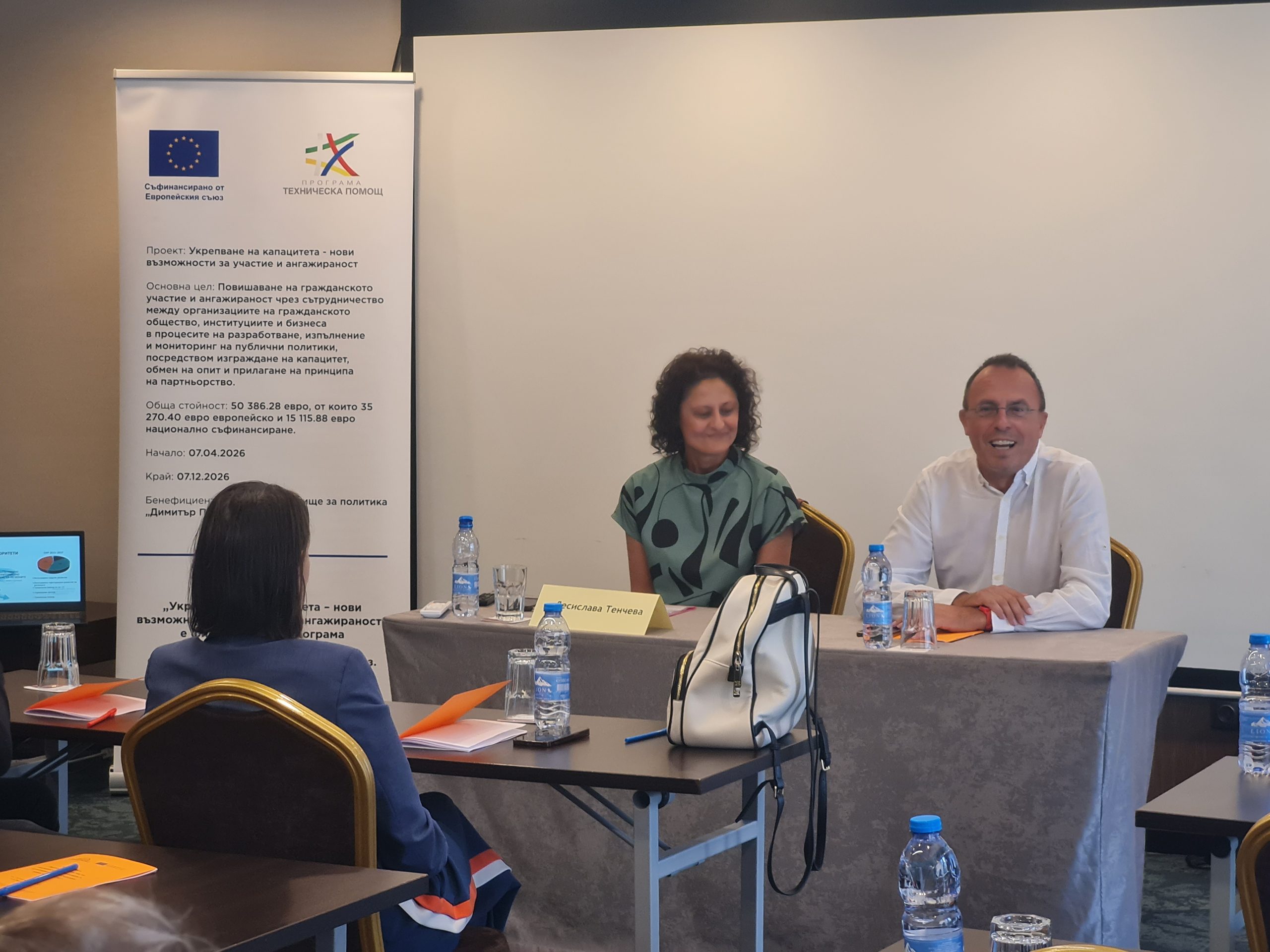
On 19 and 20 September 2026, a roundtable entitled “Partnership Participation of Civil Society Organisations in Integrated Territorial Investments (ITIs)”, organised by the Bulgarian School of Politics “Dimitry Panitza” was held at Hotel Lion in Borovets,. Over the course of two days, representatives of civil society organisations, public institutions and local authorities discussed opportunities for more active and meaningful participation of civil society in the planning and implementation of Integrated Territorial Investments.
The event was opened by Ivan Nachev, Executive Director of the Bulgarian School of Politics “Dimitry Panitza”. During the first thematic session, Desislava Tencheva, State Expert “INTERREG-IPA Cross-Border Cooperation Programmes” at the Directorate for Territorial Cooperation Management, Ministry of Regional Development and Public Works, presented ITIs as a new model for regional development and partnership. Participants discussed the main features of the approach, the importance of territorial partnerships and the role of different stakeholders. A practical perspective on the process of preparing and building local partnerships was provided by Tanya Hristova, Mayor of Gabrovo Municipality, who shared her experience in developing ITI concepts and fostering cooperation between local authorities and partner organisations. The second day focused on moving “from consultation to joint decision-making.” Maria Metodieva, Director of Institutional Partnerships at the Trust for Social Achievement, presented opportunities for more meaningful participation of civil society organisations in ITIs and discussed the challenges of transforming partnership from a formal process into a genuine instrument for jointly defining priorities and making decisions.
An important part of the programme was dedicated to practical work in small groups. Participants worked on case studies related to building partnerships, defining common objectives and identifying mechanisms for the meaningful involvement of civil society organisations in decision-making processes.
A key conclusion from the discussions was the need for sustained dialogue between civil society organisations, local authorities and public institutions, based on shared responsibility, exchange of expertise and meaningful participation in shaping decisions for the development of local communities.
The round table is part of the project “Capacity Building – New Opportunities for Participation and Engagement”, funded under the Technical Assistance Programme (TAP), co-financed by the European Union.