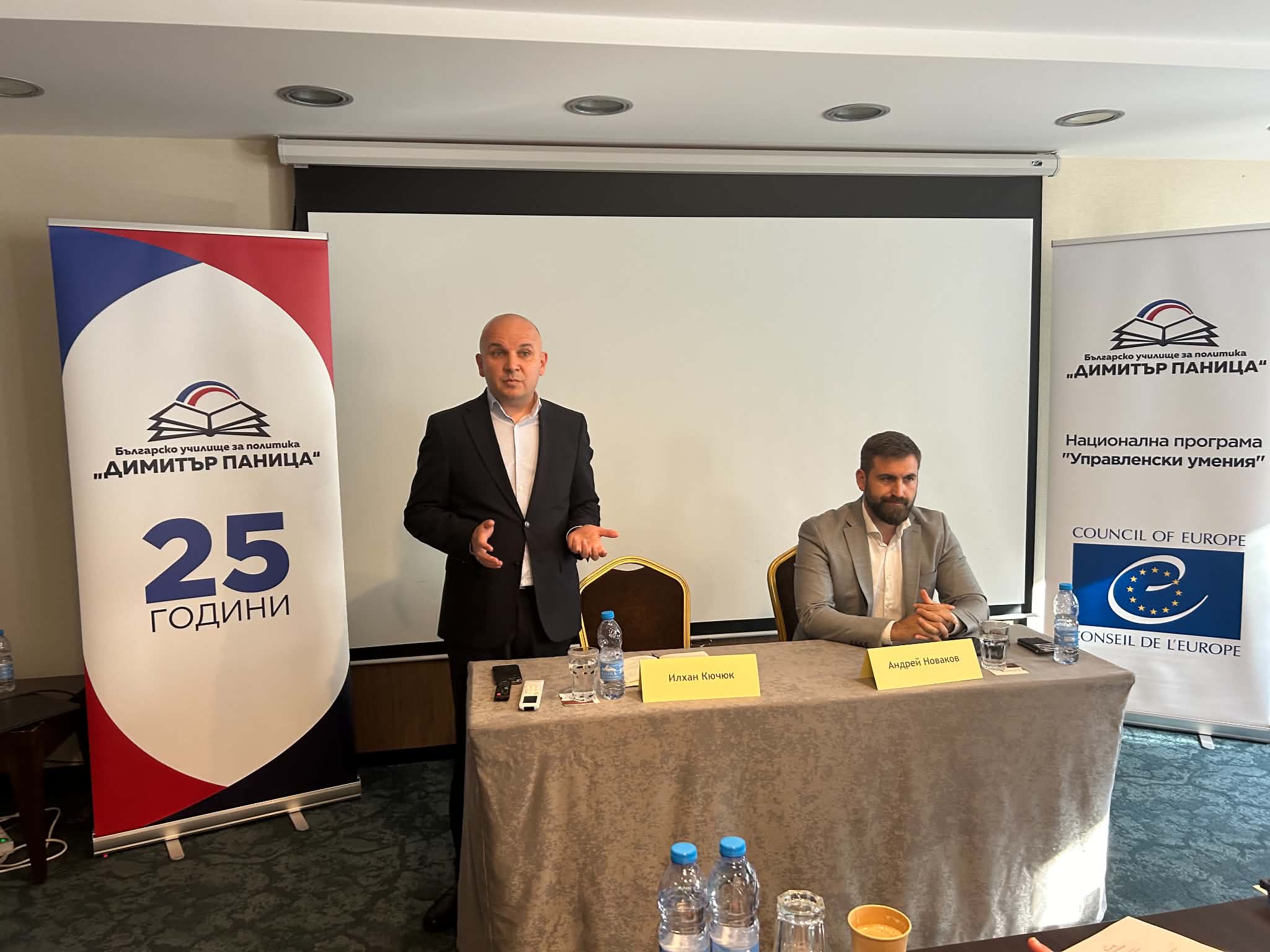
The future of the European Union, human rights, global risks and security were among the key topics addressed during the fourth and final course of the 2026 National Program “Governing Skills” of the Bulgarian School of Politics “Dimitry Panitza”. Over the course of four days, participants discussed international developments that are increasingly shaping public policies and decision-making in Bulgaria.
The course was opened by Yavor Gechev, Chair of the Committee on Agriculture, Food and Forestry in the National Assembly. In his presentation, he focused on the development of European agricultural policies and their impact on Bulgaria.
The European agenda was at the heart of the training from its very first day. Members of the European Parliament Andrey Novakov and Ilhan Kyuchyuk discussed with the participants the European Union’s recovery from a succession of crises and its changing political priorities. Yonko Grozev, Judge at the European Court of Human Rights from 2015 to 2024, presented the European human rights protection system and spoke about the state of human rights in Bulgaria.
Yasen Georgiev, Executive Director of the Institute for Economic Policy, offered a broader perspective on Europe and the world in an era of turbulence, as well as on the tools for addressing risks and uncertainty. Prof. Velizar Shalamanov examined contemporary challenges to national and international security.
Other topics covered during the course included the management and control of EU funds and the challenges facing the 2028–2034 programming period, presented by Prof. Savina Mihaylova-Goleminova. Prof. Ingrid Shikova focused on the European institutions and the ability of the EU’s complex institutional system to respond to crises. Prof. Aleksandar Hristov spoke about crisis communication, while Anatoliy Paziyski introduced participants to the rules of state and diplomatic protocol, ceremonial procedures and business etiquette.
Practical work was once again an important part of the training. Working in small groups, the participants analysed case studies, developed solutions and defended their positions. On the first day, they took part in separate workshops with Andrey Novakov and Ilhan Kyuchyuk, where they discussed the priorities of the two Members of the European Parliament. During the following days, the group work continued through practical assignments, presentation of results and feedback.
The course dedicated to international policies marked the completion of the 2026 National Program “Governing Skills”. The four courses explored the different levels at which public policies are shaped and implemented – from local government and national institutions to European policies and global processes. In this way, participants had the opportunity not only to broaden their knowledge, but also to develop the analytical, communication and decision-making skills essential for public leaders operating in an increasingly dynamic and interconnected environment.