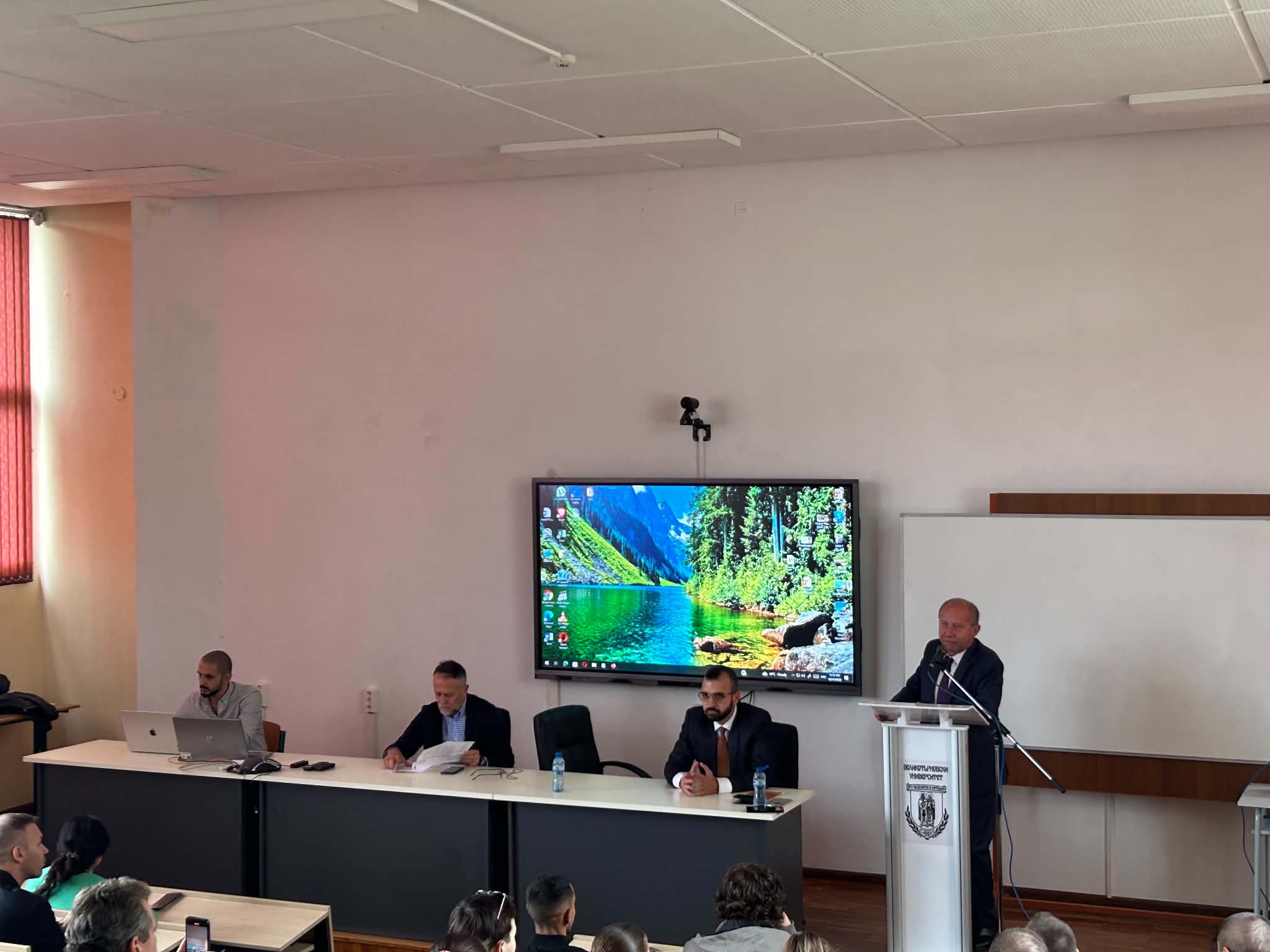
How are laws made, how can young people take part in discussing them and where is the line between using artificial intelligence as a helpful tool and letting it replace one’s own work? These questions were at the heart of an educational event held at St. Cyril and St. Methodius University of Veliko Tarnovo on 14 October. A Member of Parliament and an artificial intelligence expert discussed education policies, new technologies and the responsibility behind the decisions we make with students. The event was organised by the Bulgarian School of Politics “Dimitry Panitza” as part of the “Educated for Education” project, implemented under the European Commission’s Erasmus+ program (Key Action 1 – KA154 – Youth Participation Activities).
The meeting was opened by the Rector of Veliko Tarnovo University, Prof. Dimitar Dimitrov. In his welcoming address, he highlighted the rapid development of technology and the need for education to preserve its fundamental purpose: developing critical thinking, knowledge and academic spirit. The Rector emphasised that technology should serve people, not control them. The event was also attended by Prof. Dr. Anna Ivanova, Vice-Rector for International Affairs.
How is a law made and who can propose amendments to it? These were some of the questions discussed with students by Dimitar Zdravkov, Member of Parliament, Chair of the Parliamentary Committee on Education and Science and an alumnus of Veliko Tarnovo University. He explained the legislative process in accessible terms, from the right of legislative initiative and the submission of a bill to its examination by parliamentary committees, votes in plenary, promulgation and entry into force. The discussion also addressed specific education policy issues, including the proposal to introduce a school subject related to virtues and religion. The topic prompted questions from students and provided an opportunity to explore different aspects of education. Zdravkov encouraged young people not to remain passive observers of public affairs, but to take an active part in shaping them. He invited students to share their ideas and proposals, including by contacting him directly.
The second part of the meeting focused on artificial intelligence and the skills that are transforming learning and work. Boris Nikolov, Director and Partner at Encorp Bulgaria (encorp.ai), highlighted the importance of responsible AI use, the risks associated with emerging technologies and the regulations governing their application.
The panel was tailored to the findings of a preliminary survey conducted among Veliko Tarnovo University students. The results showed that artificial intelligence has already become a widely used tool, while significant questions remain about its regulation, the reliability of AI-generated information and the boundary between legitimate assistance and replacing one’s own work. Rather than remaining at the level of general predictions about technology, the discussion focused on practical situations that students may encounter in their everyday lives.
The educational meeting was moderated by Prof. Ivan K. Ivanov from the Department of Psychology at Veliko Tarnovo University.
The event in Veliko Tarnovo was the first of six educational discussions planned under the “Educated for Education” project. Through these discussions, the Bulgarian School of Politics “Dimitry Panitza” aims to encourage students to engage more actively in debates on education policy, develop critical thinking skills and use new technologies consciously and responsibly.